

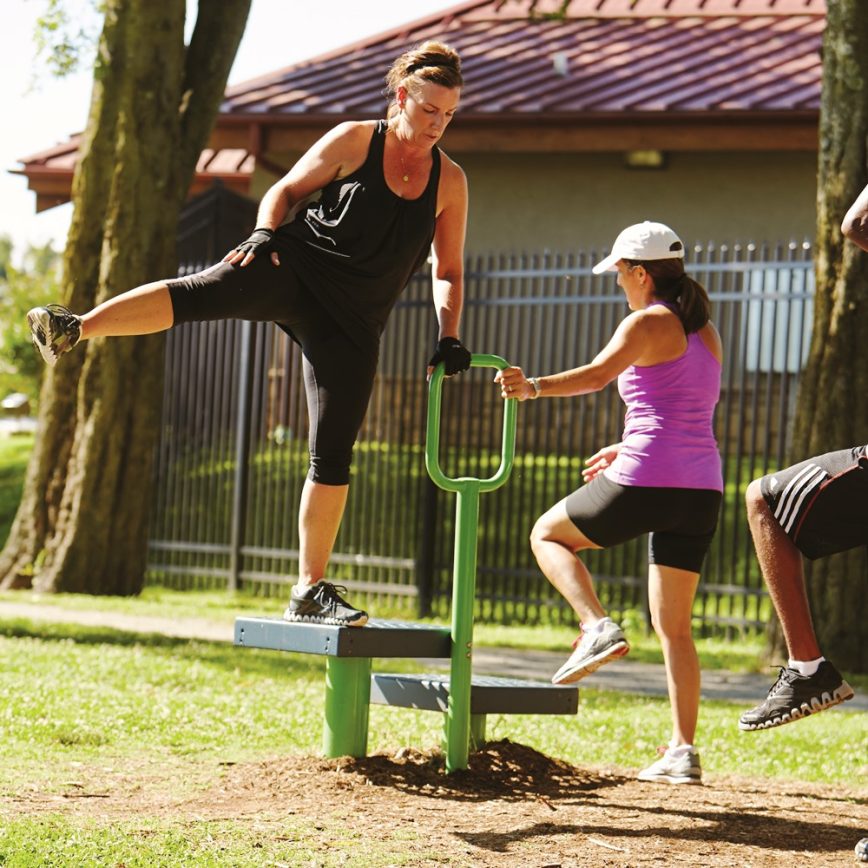
Designing an outdoor fitness circuit involves more than just choosing equipment and placing it in a park. From site prep and layout to accessibility and long-term maintenance, there’s a lot to consider before the first piece goes in the ground. We asked the experts at ActionFit Outdoors to share their top tips for building a circuit that serves your community, fits your space, and delivers a complete fitness experience.
1. Plan Your Layout
Before installing outdoor gym equipment, spatial planning sets the foundation for everything else. Equipment layout and multi-user functionality play a large role in the amount of space required. Some equipment has a compact footprint that functionally links pieces in a multi-user configuration; those environments can be as small as 350 sq ft and still serve as an effective layout for a multiple-exercise space. Larger courses with more equipment pieces can range from 500–1,000 sq ft and beyond.
Every outdoor fitness piece also includes a recommended minimum space to operate it safely, accounting for the space needed for the user and equipment during use, plus a clearance area in the event of a fall. Using that recommended minimum space as your guide will help determine which pieces can fit within your designated area.
Beyond square footage, the type of exercise and the target muscle group for each piece should factor into your plan. A balanced mix of cardio, muscle- and strength-building (including upper- and lower-body focus), and flexibility-improving pieces will deliver the most complete experience for users.
Safety surfacing and site preparation make a huge impact on your outdoor fitness space. Accounting for the slope, grade, and subbase of your site will improve drainage and long-term usability. Safety surfacing is now required on some pieces of outdoor fitness equipment. For a polished, low-maintenance finish, unitary surfaces such as Poured-in-Place (PIP) rubber, turf, or bonded rubber are excellent choices. Loose-fill options like shredded rubber and Engineered Wood Fiber (EWF) are more budget-friendly but require borders to contain the material and periodic refills as they settle or get displaced.
2. Build a Balanced, Functional Circuit
A well-designed outdoor gym delivers a complete fitness experience, and that starts with covering all five elements of fitness. To maximize health benefits, a well-rounded exercise program needs to contain a variety of elements, each offering specific results for overall health:
- Aerobic fitness: Cardio pieces such as the Cardio Walker or Hand Cycler provide an effective aerobic workout.
- Muscle fitness: Generally, the most popular element; your space can accommodate more muscle-fitness equipment. Advanced users will appreciate strength-building pieces such as the chest press or lat pull-down.
- Core fitness: Static pieces that accommodate users of most conditioning levels work well here.
- Balance: Often overlooked, but important to include at least one balance piece for a well-rounded circuit.
- Flexibility: Equally overlooked, including a flexibility piece, rounds out the five elements and benefits users of all fitness levels.
Many static pieces can develop muscle fitness, core fitness, balance, and flexibility across the lineup and have the added benefit of accommodating users of most conditioning levels.
When it comes to progressive difficulty, including a variety of components is key to welcoming less-conditioned users while still challenging advanced users. A circuit with only resistance-based strength-building pieces could prove intimidating for new users. Conversely, a space with only static pieces could seem too simple for experienced athletes. Combining both, along with cardio pieces, creates a welcoming environment where users can start with familiar, comfortable pieces while still having the opportunity to experiment and advance along their fitness journey.
Every well-rounded circuit should include a few staple pieces across each fitness element:
- Muscle fitness: Pull-up and chin-up bars are a budget-friendly way to incorporate muscle training
- Core fitness: Sit-up stations and Captain’s Chairs are consistently popular
- Aerobic fitness: Cardio Walkers, plyo boxes, and hurdles
- Balance: Balance Planks
- Flexibility: Stretching stations or shoulder rotators
3. Design for Your Community
The most effective outdoor gym installations are designed to serve users of all ages, abilities, and experience levels. Having a variety of equipment in a fitness space helps appeal to a broader range of users — ADA-compliant equipment creates access for a wider range of abilities, fitness equipment designed for ages 60+ helps create a multi-generational experience, and siting the space near playgrounds gives families and users of all ages the opportunity to benefit simultaneously.
Traditional static pieces have a wide range of uses, and users can adjust their exercises based on their conditioning level. Ensuring your circuit includes a variety of equipment — static pieces, cardio pieces, and strength-building pieces — accommodates many users of varying conditioning levels at the same time. Pieces that include resistance offer a different experience than body-weight or static pieces, adding another layer of scalability for mixed-ability groups.
ADA accessibility involves both the route to the space and the equipment itself. A connected accessible route of travel must allow mobility devices to reach the fitness space, accounting for minimum width, maximum slope, turning space, clear space, and appropriate surfacing from parking and site entrances. Each station must also include adequate clear floor space for a mobility device, and equipment design must account for reach heights, transfer heights, and grip design to accommodate users in mobility devices.
Signage is another critical component of fitness space safety. It must be permanently attached to the equipment, clearly visible to the user, and include operating instructions, age restrictions, and manufacturer identification. A best practice is to include signage with a QR code linking to a how-to video, so users can see proper equipment use demonstrated in real time.
4. Keep Your Outdoor Gym in Top Shape
A well-maintained outdoor fitness circuit protects users and extends the life of your investment. Ongoing maintenance should include regular inspection and tightening of hardware; inspection of equipment for tight fittings and wear and tear; and inspection of safety surfacing for appropriate thickness based on the equipment’s required critical fall height.
Start Planning Your Outdoor Fitness Circuit
ActionFit’s team of outdoor gym equipment specialists can help you plan a circuit that fits your space, serves your community, and withstands years of use. Contact us today to start the conversation or request a quote.


Recent Comments